 Search
 Search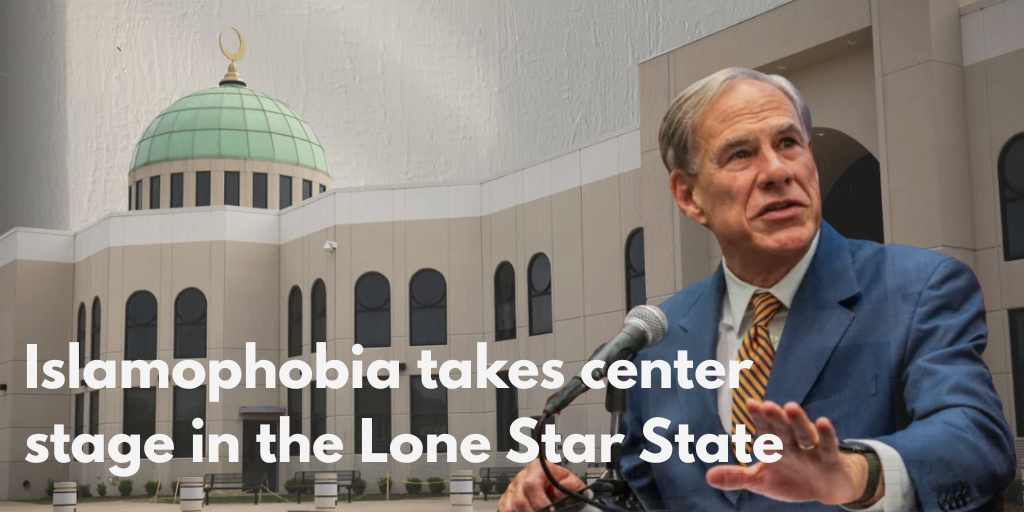
Islamophobia takes center stage in the Lone Star State
When Zohran Mamdani won the November 2025 election to become the first Muslim American mayor of New York City, his victory sparked hope amongst Muslim Americans. Many saw it as a sign that perhaps demonizing Muslims and their faith for political gain might finally be losing its power. After all, Mamdani won, despite millions of dollars poured into opposition campaigns that focused less on his policy positions and more on his identity as a Muslim.
The Islamophobic narrative directed at Mamdani drew heavily on longstanding anti-Muslim stereotypes. His opponents and critics cast him as a threat not only to New York City, but to American society as a whole, portraying his candidacy as a civilizational risk to the very notion of American identity. This fearmongering relied on familiar anti-Muslim tropes of disloyalty and insinuations that Mamdani was not a “true” American.
Some opponents even darkened his complexion and exaggerated the length of his beard in political advertisements. Numerous pundits and GOP politicians went so far as to link him to the 9/11 attacks. When Mamdani rightly called out the bigotry directed at him and millions of other New Yorkers, right-wing politicians downplayed the consequences of Islamophobia. From elected officials to voices on social media, Islamophobic rhetoric reached levels not seen since the 2016 presidential election, which ushered in the first Trump administration.
Mamdani’s win was not just historical and monumental in the sense of a having a candidate of color, but it was a massive shift in electoral politics showing that the tool of anti-Muslim bigotry in elections may not be as useful as it once was.
However, a strategy built on fear and rooted in centuries of bigotry and that’s been effective for the better part of the last 25 years doesn’t just disappear overnight. The best example of this was Alabama Senator Tommy Tuberville’s grotesque tweet during Mamdani’s swearing in ceremony,where he said “The enemy is inside the gates”.
Islamophobia endures because it’s built upon centuries of racialized stereotypes. It is an ideology and system of oppression rooted in fear, which has long been a powerful unifying force in American politics. Given fear is one our most primal instincts, appeals to this emotion often provoke strong reactions. We are wired to detect threats and to protect ourselves from perceived danger. So, when politicians and media figures tell the public that Muslims are “taking over” the Lone Star state, that Sharia law will replace the Constitution, or that their way of life is under threat, it is unsurprising that some people feel compelled to act. And how should they respond? By voting for the GOP politicians who amplify and capitalize on that fear.
Currently in Texas, we are witnessing a resurgence of the Islamophobia that marked the 2010s. This period involved hysteria and relentless anti-Muslim rhetoric from voices such as the Tea Party (the ideological precursor to the MAGA movement) to grassroots organizations such as Act for America. These groups and individuals stoked fears of a so-called “Sharia takeover” and fixated obsessively on the specter of “radical Muslims.” As Texans head to the polls next month for primary elections, it appears that some GOP candidates are reviving this familiar playbook, once again vilifying Muslims in an effort to mobilize voters.
During the 2010s, lawmakers across the country introduced 231 anti-Sharia bills in an effort to institutionalize the exclusion of Muslims under the guise of protecting Americans against “foreign law.” Many of these bills were modeled on draft legislation written by attorney David Yerushalmi, described by the Southern Poverty Law Center as the the “father of the anti-Sharia movement.” A 2018 report by the Haas Institute for a Fair and Inclusive Society at UC Berkeley, found that Yerushalmi’s draft bill served as a model for “the enactment of 18 anti-Muslim laws in 12 states in the US between 2010 and 2016.”
In 2010, Yerushalmi co-authored a report published by the Center for Security Policy, titled Shariah: The Threat to America. At the time, CSP, under the wing of anti-Muslim conspiracy theorist, Frank Gaffney, was one of the key organizations disseminating Islamophobic “research”, which was used by lawmakers to support their discriminatory legislations. The report recommended barring individuals who “espouse or support shariah” from serving in government or the armed forces. It also suggested that imams and mosques advocating for sharia in the United States be prosecuted for “promoting seditious activity.”
The hate-filled frenzy extended beyond reports and legislative measures. In 2017, ACT for America—the largest grassroots anti-Muslim organization in the country—organized a nationwide “March Against Sharia.”
Today, the “Sharia takeover” narrative is ripe and rampant in Texas. In November 2025, Governor Greg Abbot called for an official investigation into so-called “Sharia courts”. No such courts exist, but factual information has never been the top priority in American politics. There are however, as Lawyer Faisal Kutty points out, “voluntary Muslim mediation panels operating under the same framework used by Jewish beth din courts and Christian arbitration services.” Abbott’s “Sharia” boogeyman came a day after he issued an executive order designating the Council on American-Islamic Relations (CAIR), the country’s largest Muslim civil rights organization, as a “foreign terrorist organization” (FTO). CAIR has played a vital role in safeguarding the civil rights of Muslim Americans; attempts to associate it with “terrorism” are nothing more than a dangerous Islamophobic smear. In his bid for a fourth term as governor, Abbott has emerged as one of the state’s most prominent figures amplifying anti-Muslim hysteria.
The constructed moral panic over “Sharia law” isn’t limited to mere rhetoric alone, rather it has led to institutional developments at the federal level: introduction of a “Sharia-free America act”, creation of the “Sharia-Free Caucus” in the House of Representatives, and a congressional hearing. At this hearing, Robert Spencer, an anti-Muslim author who promoted these bogus and bigoted claims the first time around in 2010s, served as a witness. All of these developments frame Sharia, and by extension Muslims, as “civilizational threats” to the United States.
To substantiate their claims of a “Sharia takeover,” some GOP politicians point to ordinary expressions of Muslim civic life: public participation, demographic growth (Muslims constitute roughly 1% to 1.7% of Texas’s total population), and involvement in community development. In effect, they frame Muslims’ engagement as active citizens, and at times their mere existence, as evidence of a broader threat.
During the February 2026 congressional hearing on Sharia, Texas Representative Chip Roy cited the proposed EPIC City housing development as proof of what he described as an impending danger. EPIC City is a planned Muslim-centered community in North Texas that is open to residents of all faiths. Nevertheless, the project’s developers were accused by Governor Abbott of attempting to create “no-go zones,” prompting a Department of Justice investigation. The investigation was ultimately dropped, as the allegations lacked legal basis and were clearly politically motivated, part of a broader strategy by GOP politicians to sustain Islamphobic fear-driven campaigning ahead of the March primaries.
Abbot’s rhetoric and actions, along with those of other Republican politicians, reinforce and legitimize a wider ecosystem of Islamophobic messaging across the state. This messaging can be tracked through data. A recent study by Equality Labs found that in 2025, more than 4.7 million Islamophobic social media posts targeted the Muslim community in the United States. Texas led the nation in anti-Muslim disinformation, with approximately 279,000 posts promoting themes such as “Muslim invasion theory,” the imposition of Sharia law, calls to investigate Muslim organizations and leaders, and calls to deport Muslims.
With the midterm elections approaching, the sitting party traditionally faces significant political headwinds. In previous election cycles, the GOP relied heavily on fear-based messaging centered on the southern border and calls for a border wall. As that strategy has lost some of its mobilizing power, Islamophobia has reemerged as a fallback electoral tool. Additionally, polling by the Israeli Foreign Ministry found that whipping up anti-Muslim racism is an effective strategy to distract indivduals from real issues (for Israel, it’s the country’s genocide in Gaza). It would therefore be reasonable to conclude that GOP politicians, many of whop remain Israel’s most ardent supporters and defenders of the genocide in Gaza, are are incorporating these findings into their own campaign strategies.
The current alarmism over “Sharia” is part of an anti-Muslim electoral playbook that has been used for decades. It is a fear-driven tactic that has repeatedly proven successful at the ballot box. What we are witnessing now is a recycling of the same anti-Muslim narratives from 15 years ago. Demonizing Muslims is politically expedient: it is simplistic, emotionally charged, and, unfortunately, often effective. However, this strategy carries serious consequences. It endangers the lives, safety and well-being of millions of Muslim Americans, while reinforcing Islamophobic discourse on the international stage. In this global climate, marked by intensified anti-Muslim violence, most starkly exemplified by Israel’s genocide in Gaza, such rhetoric does not merely divide; it actively legitimizes and perpetuates further harm.