
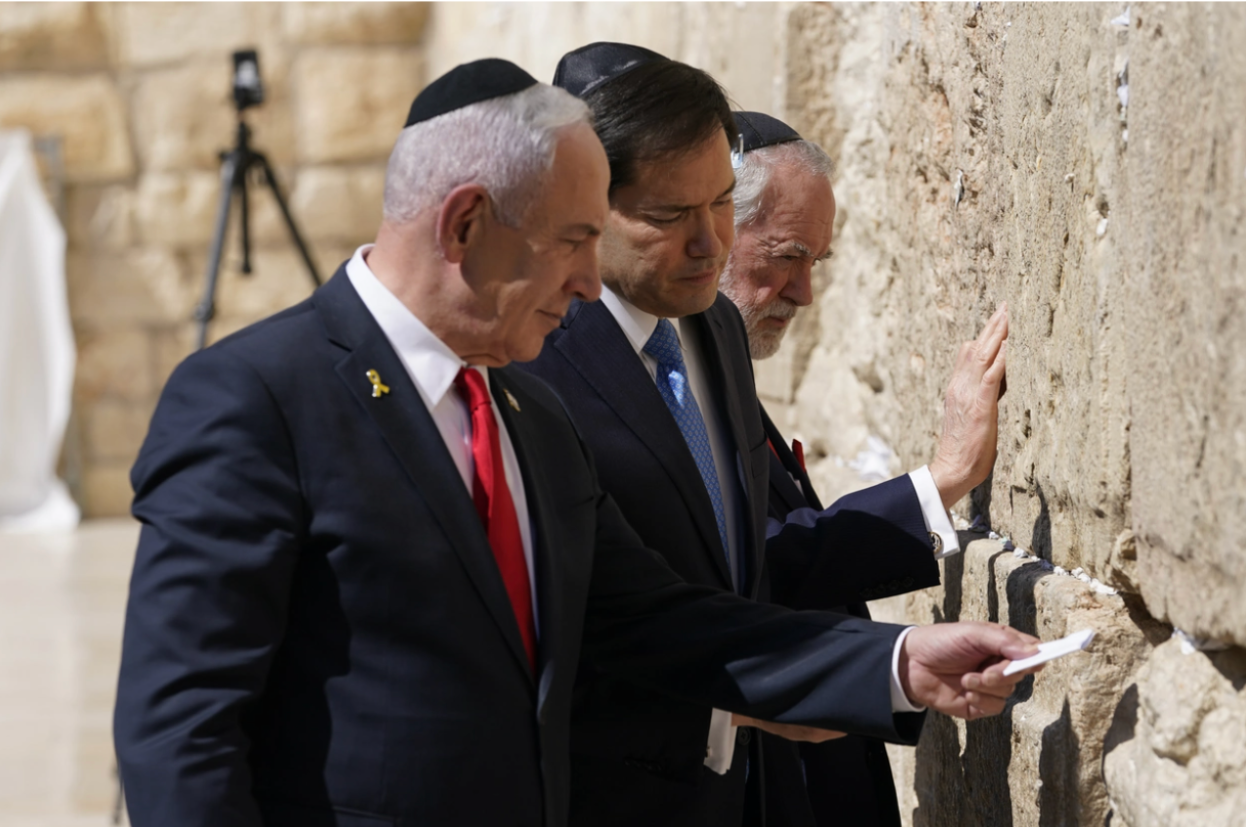
Image source: Nathan Howard/Pool Photo via AP
Civilization Talk: How Politicians Use ‘Judeo-Christian’ to Cast Muslims as a Threat
Nigel Farage
“We do have, I’m afraid, I’m sad to say, a fifth column that is living within our own countries, that is utterly opposed to our values… We’re going to have to be a lot braver and a lot more courageous in standing up for our Judeo-Christian culture.” (source: BBC)
Geert Wilders
“Our Judeo-Christian culture is far superior to Islam and we should not be afraid to say so.” (source: MEF)
Mike Huckabee
“America and Israel are bound together by our shared Judeo-Christian values. Our destinies are intertwined.” (source: Jerusalem Post)
Benjamin Netanyahu
“He [Charlie Kirk] was a defender of our common Judeo-Christian civilization.” (source: Fox News)
The quotations above from prominent western politicians reflect a dominant discourse in contemporary politics—one that invokes the term “Judeo-Christian” less as a genuine reference to theological commonalities and shared heritage and more as a mechanism of cultural and racialized exclusion. In the post-9/11 climate of securitized and hostile politics, this discourse has increasingly functioned to construct Islam and Muslims as the civilizational “other.” By fusing ethno-nationalist populism with religion, the notion of a “Judeo-Christian tradition” has been mobilized as a symbolic “barrier against Islam,” framing Muslims—constructed as the religious and racial “other”— as threats to Western values and civilization.
The terminology and framing is present across the political spectrum, from the left to the right. “Judeo-Christian” is frequently invoked in political spheres when discussing vague notions such as values and heritage. As the quotes demonstrate, in today’s context, the term is often deployed as a tool of exclusion- most notably to “otherize” Muslims.
History of the term
The phrase “Judeo-Christian” has not always carried this exclusionary force. As journalist Michael Sean Winters traces, the term originated in the 19th century as a descriptive and analytical category. It became politicized in the mid-20th century, particularly in response to the rise of antisemitism in Europe and the United States. During this time, “Judeo-Christian” was employed by organizations to “indicate a common religious cause” in opposition to rising fascist and antisemitic views. It is important to note that some critical Jewish voices see the idea of a “Judeo-Christian tradition” as an ideologically motivated myth that was mobilized in postwar Germany and Europe as a means to whitewash 2,000 years of anti-Jewish pogroms and persecution that led to the Holocaust. Following World War II and the defeat of Nazism, the term gained further traction as pastors and politicians deployed it in Cold War rhetoric to contrast “Judeo-Christian civilization” with “godless communism.”
Following the 1979 Iranian revolution, interfaith spaces and academic centers adopted the term “Abrahamic” to point to what the three religions of Christianity, Islam, and Judaism had in common. It was used more so from a theological and interfaith perspective, highlighting the shared history. However, Winters notes that during this period, “Judeo-Christian” terminology was widely adopted by the Christian right, which became a significant force in American politics during the 1970s and 1980s. What began as a tool to counter fascism and antisemitism has, in the 21st century, been reoriented toward demonizing Islam and Muslims.
Post-9/11 Usage and Civilizational Rhetoric
The attacks of September 11, 2001, marked a turning point in the deployment of “Judeo-Christian” rhetoric. Politicians, pundits, and religious leaders framed the violence as evidence of a civilizational conflict, positioning the “Judeo-Christian West” in opposition to “radical Islam.” As Winters points out in his article, back in 2002, the American evangelist Franklin Graham remarked that, “The God of Islam is not the same God of the Christian or the Judeo-Christian faith. It is a different God, and I believe a very evil and a very wicked religion.”
The injection of “Judeo-Christian” rhetoric to signal a civilization threat drew heavily on the works of neo-conservative academics. Samuel Huntington’s “Clash of Civilizations” thesis, itself influenced by Bernard Lewis’s “The Roots of Muslim Rage,” argued that following the Cold War, the dominant global conflict would be over cultural and religious lines. Both scholars positioned Islam as a perennial rival to “Judeo-Christian heritage.” Such claims entrenched the binary of Islam versus the West, reinforcing Islamophobic narratives (namely that Islam and Muslims are connected to violence- Huntington famously claimed that Islam has “bloody borders” and “bloody innards”) that deeply influenced George W. Bush’s administration following the 9/11 attacks. This Islamophobic and civilization framing helped garner support and justify the borderless and timeless “War on Terror”. Today, it continues to shape US policy and public discourse.
The Political Function of “Judeo-Christian”
Although “Judeo-Christian” terminology is occasionally framed in theological terms—as in the anti-Palestinian rhetoric of evangelical Christian Zionists like the current US Ambassador to Israel, Mike Huckabee—its contemporary function is primarily political. It is invoked to justify exclusionary policies, securitization measures, and imperial violence. For instance, Huckabee and other Christian Zionists deny the existence of Palestine and Palestinians, including Palestinian Christians, while supporting Israel’s military actions that target churches and Christian communities in Gaza.
In this sense, the “Judeo-Christian” terminology operates on both racial and religious registers: Arabs and Muslims are simultaneously marked as racialized and religious outsiders. The “Judeo-Christian” frame legitimizes the view of Muslims as existential threats to Western civilization, thereby providing ideological cover for military interventions abroad targeting Muslim-majority countries and discriminatory policies against Muslims and Arabs at home. It is also a cornerstone of America’s relationship with Israel, with many American pro-Israel and pro-Zionist voices using this framing to justify their unconditional support of Israel. The civilization threat discourse has been essential to western imperialist missions and has been heavily favored by several American administrations.
“Judeo-Christian” and Israel
The racialized discourse also converges with geopolitical interests, particularly in relation to Israel. Despite its location outside the geographic West, Israel (a settler-colonial state in the Middle East) has been incorporated into the “Judeo-Christian” framework as a civilizational ally. In this framework, Israel’s Jewish population, which has roots all over the world, is viewed as “part of a white, Christian-dominated geopolitical bloc.” Shaul Magid, Rabbi and Visiting Professor of Modern Jewish Studies at Harvard Divinity School, has argued that the “historical pact between Jews and Muslims has been subverted such that the Christian now becomes the political ally of the Jew against the Muslim through the ‘Judeo-Christian’ expressed, in part, through American fidelity to Israel.”
Along with Muslims, this “shared tradition” also excludes those who are considered the “wrong” Jews, primarily Jewish individuals who support the rights of Palestinians, who disagree with US imperialism, and are critical of Israeli politics. For example, US-based Jewish-American organizations like Jewish Voice for Peace (JVP) are routinely criticized and sidelined by fellow Jewish-American organizations like the Anti-Defamation League (ADL) due to their support for the rights of Palestinians and criticism of Israel. In the modern context, this demonstrates that the “Judeo-Christian” framework often serves as a political tool rather than a description of shared history. In this scenario, the “Judeo” is restricted to one that is “assimilated to western Christian hegemony.” Additionally, there has been dissent from many Jewish voices against the terminology. They argue that it obscures theological differences between Judaism and Christianity, and serves as a “political assemblage offering conditional, incomplete access to structures of white, western Christian power.”
The term Judeo-Christian is also prevalent amongst Israeli politicians, with Prime Minister Benjamin Netanyahu incorporating “Judeo-Christian” rhetoric into his speeches to frame Israel as a partner of the Christian West against Islam. This rhetoric has intensified in the context of Israel’s ongoing genocide in Gaza, where Palestinian Muslims and Christians alike are dehumanized as civilizational enemies, so that the violence and brutality acted upon them is subject to little criticism from western nations. Palestinians are portrayed as a civilizational “other” and to protect “Judeo-Christian” civilization, Israel must carry out this violence against them.
Recently, Israeli officials have also begun using explicit Islamophobic rhetoric aimed at stoking division and fear within the West, namely Europe, claiming that Muslims on the continent are a “fifth column” and “enemy within.” Many of these statements echo global anti-Muslim far-right conspiracy theories of demographic and cultural takeover
Contemporary Implications
In today’s conversations, “Judeo-Christian” functions far less as a celebration of shared values between Jews and Christians and far more as a marker of exclusion aimed at Muslims. It is much less about commonalities or shared values between Christians and Jews, and more about how Muslims are not only different from these groups, but pose a threat to these communities.
In many western countries today, this terminology is “most often used to draw a line between imagined Christian values and a perceived (but false) threat of Muslim immigration.” Politicians have instrumentalized this framing to justify increasingly restrictive and punitive immigration policies. This was evident at the September 2025 “Unite the Kingdom” rally in London, where numerous speakers denounced immigration through a civilizational lens, portraying Muslims (used interchangeably with immigrants/migrants) as an existential threat to the “Judeo-Christian” heritage and values of European nations. They also repeatedly argued that immigrants were to blame for the socio-economic situation facing British individuals. As scholars and critics note, the discourse operates as a scapegoating mechanism, displacing Europe’s and America’s social and political crises onto Muslims.
Conclusion
The evolution of “Judeo-Christian” discourse reveals its transformation from an interfaith strategy against fascism and antisemitism to an exclusionary device aimed at Muslims. In contemporary political rhetoric, it is deployed as a civilizational marker, legitimating imperialism abroad and Islamophobia at home. By framing Islam as an existential threat, the discourse reinforces far-right agendas of exclusion, division, and violence, while masking itself as a defense of shared “Western values.”