 Search
 Search
(Bingjiefu He)
When a Win Sparks Hate: Islamophobia After Mamdani’s Victory
Zohran Mamdani has made history as the first Muslim to become the Democratic candidate for New York City Mayor. The democratic socialist’s campaign centered on a bold progressive vision aimed at making New York City more affordable, including proposals to provide free bus service and childcare, implement a rent freeze, and increase taxes on wealthy corporations. Mamdani succeeded in mobilizing broad grassroots support, ultimately defeating former New York Governor Andrew Cuomo—long considered a political heavyweight.
Throughout his campaign, Mamdani was the target of anti-Muslim and anti-Palestinian voices, many of whom alleged that having him as a mayor threatened America and put the safety of Jewish New Yorkers at risk. For them, Mamdani’s support of Palestinian rights was evidence of his alleged antisemitism. These voices invoked the Islamophobic trope that Muslims are inherently antisemitic.
These comments circulated widely despite the fact that Mamdani received significant support from Jewish constituents. Notably, his campaign was cross-endorsed by Brad Lander (New York City comptroller) and many Jewish New Yorkers actively participated in his coalition. Mamdani stated that he had spoken to Jewish constituents, listening to their concerns at local Synagogues and having conversations with the community, vowing to speak out against rising antisemitism and promising to build a city where everyone is safe and protected from hate. Despite this, the harassment and vitriol continued, so much so that Mamdani noted he had received multiple death threats, including voicemails threatening to blow up his car, leading to an investigation by the New York Police Department (NYPD). Mamdani stated that the threats took a toll on him, stating “I get messages that say the only good Muslim is a dead Muslim. I get threats on my life, on the people that I love.”
Following his win, politicians and social media commentators unleashed their anti-Muslim bigotry. In an effort to incite public fear, Mamdani was labeled with inflammatory terms such as “Islamist” and “jihadist terrorist,” and portrayed as inherently dangerous, violent, and untrustworthy. For those who harbor anti-Muslim prejudice, Mamdani’s Muslim identity was treated as sufficient grounds for suspicion—an approach that exemplifies textbook religious discrimination. This framing suggests that Muslims are unfit for positions of power solely because of their faith.
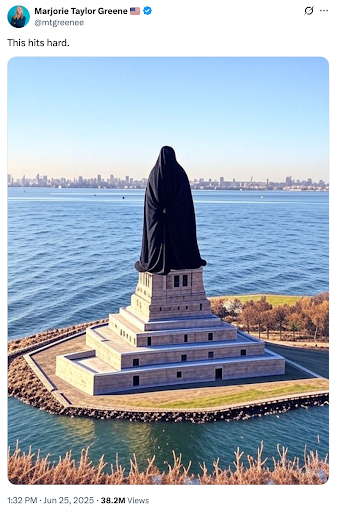
Following Mamdani’s win, Congresswoman Marjorie Taylor Greene (R-GA), a supporter of far-right conspiracy theories who has a history of making extreme antisemitic and anti-Muslim comments, posted an image of the Statue of Liberty in a burqa on X. The post appeared to tie Mamdani’s win to Muslim women’s dress, aimed at evoking fears of an “Islamic invasion,” something which Taylor Greene has a history of claiming. It is worth pointing out that the original design for the Statue of Liberty was actually an Egyptian Muslim woman.
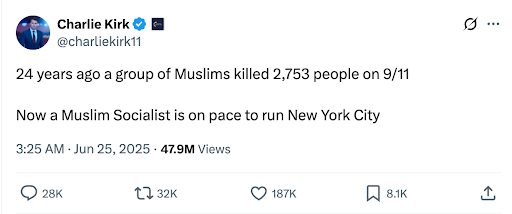
Founder of Turning Point USA, Charlie Kirk, referenced the 9/11 attacks in his post following Mamdani’s win, clinging to the Islamophobic claim that Muslims were responsible for the deadly attack that occurred in 2001.
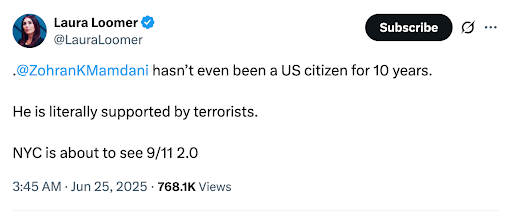
Far-right social media personality, Laura Loomer, also invoked 9/11 in an attempt to stoke fear and spread Islamophobic sentiment. Loomer, who is banned by several riding-sharing apps for her anti-Muslim hostility, has called Islam a “cancer” and described Muslims as “savages”. She alleged that Mamdani is “supported by terrorists,” and warned that with his win, New Yorkers would see “9/11 2.0.” Another individual who amplified the anti-Muslim trope tying Muslims to terrorism, was Donald Trump Jr, who shared a post reading, “I’m old enough to remember when New Yorkers endured 9/11 instead of voting for it,” adding: “New York City has fallen.”
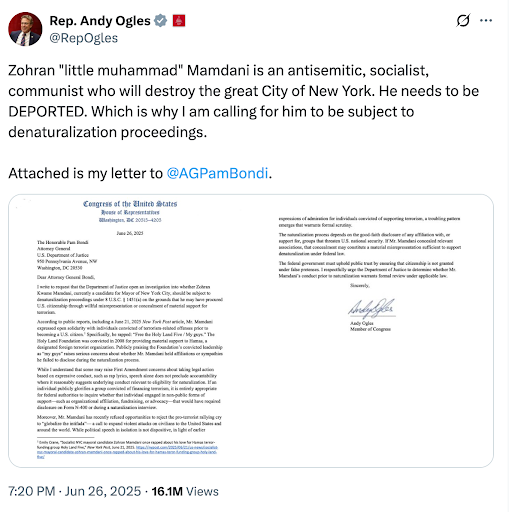
Along with Taylor Greene, several other Republican members of congress engaged in Islamophobic rhetoric. Congressman Andy Ogles (R-TN) called Mamdani “little muhammad,” and said he should be deported. In a post on X, he published his letter to the Attorney General calling for her to open up denaturalization proceedings, alleging that Mamdani’s old rap lyrics were sufficient evidence for the government to open an investigation into his citizenship application.
The Guardian also reported that New York Republican representative Elise Stefanik sent fundraising emails branding Mamdani a “Hamas terrorist sympathizer” before the race was even called. Additionally, in a radio interview, New York City councilwoman Vickie Paladino described him as a “known jihadist terrorist” and “communist”, echoing the calls from Ogles by demanding Mamdani, a US citizen, be deported.
It was not only Republicans who expressed their anti-Muslim hostility following Mamdani’s win. New York Democratic senator, Kirsten Gillibrand went on an anti-Muslim tirade on June 26th,, demonstrating that Islamophobia is present on all sides of the political spectrum. On The Brian Lehrer Show, Gillibrand stated that her constituents were “alarmed” by Mamdani’s past public statements, “particularly references to global jihad.” This appeared to allude to the phrase “globalize the intifada”—a slogan that Mamdani has never used, nor has anyone affiliated with his campaign.
Despite this, Gillibrand and others continued to pressure Mamdani to “condemn” the phrase. For many American Muslims, this pattern is all too familiar. As Basim Elkarra and Edward Ahmed Mitchell noted, “For decades, Muslims in America have been held to a ridiculous, bigoted double standard which demands that we condemn violence that we had nothing to do with and renounce comments that we have never made.” Mamdani responded to these allegations, arguing that the phrase “has been deliberately misinterpreted to smear him and others who stand up for Palestinian rights.”
His experience illustrates how Muslim political figures are routinely subjected to selective scrutiny and misrepresentation based on unfounded claims. In an MSNBC interview, Mamdani described the words from both Republicans and Democrats as a “language of darkness and a language of exclusion.”
These posts were part of a broader online campaign of harmful and demonizing discourse targeting Mamdani, which intensified significantly in the days surrounding the election. A new study by the Center for the Study of Organization Hate (CSO) found that “From June 13 to June 23, 2025, traffic about Zohran Mamdani that met our keyword search criteria held between 56 and 264 hateful posts per day. On the day of the primary on June 24, 2025, the volume jumped to 899 keyword-matched posts. On June 25, 2,173 keyword-matched posts were published.” The report found that the discourse on Mamdani was “shaped by overlapping narratives of Islamophobia, ideological fear-mongering, and xenophobic attacks.” Amongst the nearly 2,000 posts the report examined, researchers found that 39% of them included “explicit anti-Muslim language–either targeting Mamdani, Muslims, or Islam more broadly within the context of mayoral primary results.”
Importantly, this climate of hostility has not remained confined to discourse alone. As Islamophobic rhetoric intensifies, so too does violence. Anti-Muslim hate crimes have surged in recent years, underscoring the real and growing threat to the safety of American Muslims. In 2024, the Council on American Islamic Relations (CAIR) received 8,658 complaints of anti-Muslim bias—the highest number since CAIR began collecting data in 1996. Specifically in Mamdani’s case, CAIR Action recorded at least “127 violent hate-related reports mentioning the mayoral candidate or his campaign in the day after polls closed.”
Beyond physical threats and violence, this surge in anti-Muslim hysteria creates a chilling effect on Muslim participation in public life. Mamdani himself has spoken about the emotional toll the threats have taken on him and his family—a burden that understandably deters many American Muslims from engaging in politics, out of fear that their faith will be weaponized against them. This exclusion carries serious implications for democratic representation in the United States.
The vilification Mamdani has faced mirrors the treatment of other Muslim elected officials—such as Representatives Ilhan Omar and Rashida Tlaib—revealing just how normalized anti-Muslim hostility has become in American political discourse. The backlash against Mamdani is not an isolated event, but rather a manifestation of deeply entrenched Islamophobic narratives that not only endanger individual lives but also fracture communal cohesion.
The response to Mamdani’s win is unsurprising given the current political and social climate in the United States. It reflects over two decades of entrenched anti-Muslim rhetoric propagated by political leaders and mainstream media. These institutions have long manufactured and circulated narratives that portray Muslims as violent, dangerous, antisemitic, and untrustworthy—tropes that have collectively contributed to the dehumanization of Muslim communities.