[Pascal Rossignol/Reuters]
PERFORMING NEUTRALITY, PRACTICING EXCLUSION: A CRITICAL ANALYSIS OF THE HIJAB BAN IN SPORTS
Written by Khayran Noor & Sandra Anya – Edited by Raphael Okochil
INTRODUCTION
Sport is hailed as a universal language, a space where people of diverse backgrounds come together in pursuit of excellence, teamwork and fair play (Amnesty International, 2024). However, beneath this ideal lies a persistent reality where racism and religious discrimination continue to shape how athletes are perceived and whether they are welcome (Amnesty International, 2024). The ḥijāb ban is one such example, a policy that undermines the very inclusivity sport claims to uphold. At its core, this conversation is about the freedom of choice (as stipulated under Article 18 of the International Covenant for Civil and Political Rights). It is also about the right of Muslim female athletes to express their identity and religion through the ḥijāb (Amnesty International, 2024). The assumption that Islam universally mandates the ḥijāb oversimplifies a complex field of interpretation, as Muslim jurists and communities have historically differed not only on its scope and obligation, but also on the very meaning of the term (Ahmed, 1992; Barlas, 2002; Abou El Fadl, 2001; Qur’an 17:45, 19:17, 33:53). This debate is not about enforcing religious dress; it is about protecting the right of those who choose to wear it. The ḥijāb, the niqab, and the abaya are diverse expressions of modesty and identity that should be protected within the sporting arena.
Banning the ḥijāb sends a message that religious identity must be erased in order to participate, which is a deeply exclusionary stance. This ban is often justified under the guise of secularism, or laïcité (Amnesty International, 2025), purportedly to maintain neutrality in public spaces by excluding religious symbols (Graaf & Brems, 2025). However, secularism ought to protect freedom of religion rather than suppress it (Giesbrecht, 2025). When neutrality becomes a tool to erase identity, it transforms into a form of discrimination (Graaf & Brems, 2025). The ḥijāb ban contradicts the core values of sportsmanship (respect, inclusion and fair competition), forcing the athlete to choose between their faith and their passion. This paper explores the intersectionality of religion, gender and governance in international sports through the lens of ḥijāb bans, examining the cultural significance of the ḥijāb, the history of ḥijāb bans and the legal and policy implications of France’s 2024-2025 ban (Graaf & Brems, 2025; Weiser, 2024).
CULTURAL & RELIGIOUS SIGNIFICANCE OF THE ḤIJĀB
The ḥijāb is far more than a garment; it is a deeply personal and multifaceted symbol that carries religious and cultural weight (Pfister, 2010). For many Muslim women, wearing the ḥijāb is an act of devotion, a reflection of modesty, and a declaration of identity (Izzatunnisa & Kudhori, 2025; Mahmood, 2005). Ḥijāb bans are often justified under the guise of liberating Muslim women from religious constraints, yet they often disempower them by denying them the right to choose how they present themselves. In effect, they replace one form of control with another, reinforcing patriarchal norms by dictating what women can and cannot wear (Abdelgadir & Fouka, 2020; el-Husseini, 2024).
The ḥijāb occupies a unique space at the intersection of religion, culture, and ethnicity. For many Muslim women, it is a religious duty rooted in Islamic teachings about modesty and piety while also serving as a cultural expression tied to heritage, family tradition, and community values. Additionally, in Western contexts, the ḥijāb functions as an ethnic marker, visually distinguishing Muslim women as part of a minority group. This layered significance means that banning the ḥijāb is not just a restriction on clothing but a denial of identity. Such bans undermine the values enshrined in the Olympic Charter (IOC, 2023) and violate international human rights norms, including the right to freedom of religion, freedom of expression, and the right to participate in cultural life (International Olympic Committee, n.d).
HISTORICAL TRAJECTORY OF THE ḤIJĀB IN SPORT
The history of the ḥijāb in sport is marked by both exclusion and gradual accommodation. In 2007, an 11-year-old Muslim girl was ejected from a youth soccer match in Quebec, Canada, for wearing a ḥijāb (CBC News, 2007). The referee cited FIFA’s 2007–2008 rulebook, which prohibited religious attire on the field (Geist, 2011). This incident sparked national outrage and ignited a broader debate about religious freedom and inclusion in youth sports (Geist, 2011). Subsequently, Quebec passed a bill in 2019 affirming the laicity of the state, banning public-service workers from wearing religious symbols such as the ḥijāb (Beck, 2022).
At the 2009 Asian Youth Games, a Bahraini girls’ basketball team was banned from competing after refusing to remove their ḥijābs (Amnesty International, 2024a). The referee, acting under the jurisdiction of the International Basketball Federation (FIBA), enforced a rule prohibiting headgear. FIBA later formalized this ban, stating that ḥijābs would not be permitted in any future sanctioned games. However, this ban was reversed in 2017, allowing ḥijābs, turbans, and other headgear on the court (Amnesty International, 2024b). In contrast to FIBA and FIFA, the International Boxing Association (IBA) adopted a more inclusive approach in 2009, ruling that athletes could wear ḥijābs beneath their headgear, provided the face remained visible (Woolf, 2009). This decision demonstrated that safety and religious accommodation are not mutually exclusive, setting a precedent for how federations can balance regulation with respect for diversity.
In April 2010, FIFA banned Iran’s youth girls’ soccer team from international competition, citing rules that equipment must not carry religious statements and that players must not wear anything deemed dangerous (Reuters, 2010). After intense negotiations, the ban was lifted in 2012, and the Iranian team was reinstated with modified uniforms (Associated Press, 2012). This period also saw commercial innovation; in 2017, Nike launched the Pro Ḥijāb (Nike, 2017), a performance-ready headscarf designed in collaboration with Muslim athletes. Made from breathable fabric, it addressed both modesty and functionality, marking a positive development in sportswear accommodating religious expression.
COMPULSORY UNVEILING IN FRANCE
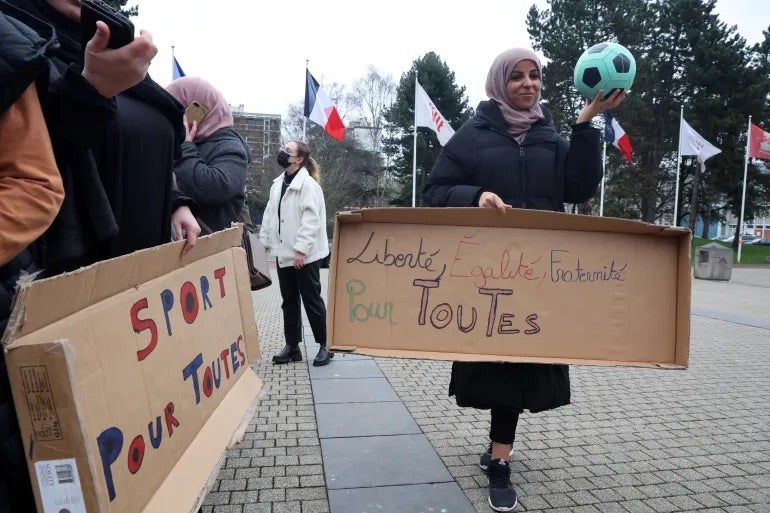
France’s ḥijāb ban in sports is the culmination of decades of legislative hostility and institutional resistance to Muslim religious visibility. While the French Constitution guarantees freedom of religion and conscience, the interpretation of laïcité has increasingly been weaponized to suppress Muslim identity, particularly for women. Article 1 of the French Constitution and the 1905 Law on the Separation of Churches and State (France, 1958; France, 1905) affirm the Republic’s commitment to freedom of religion. However, this freedom is conditioned by the principle of state neutrality, which has been interpreted to mean the absence of religious symbols in public institutions. For ḥijāb-wearing athletes, this means being forced to choose between faith and participation, a choice that undermines both individual autonomy and human rights.
France’s legislative history reflects this tension. In 2004, the French Parliament passed the Application of the Principle of Secularity law, banning all “ostentatious” religious symbols in public schools (Amnesty International, 2024a). In 2010, France passed a law banning burqas and niqabs in public spaces, citing security and social cohesion. Although the ḥijāb was not included, the law reinforced the narrative that visible Muslim religious attire is incompatible with French public life. The French Football Federation (FFF) banned ḥijābs during matches in 2015, despite FIFA’s 2014 approval of headscarves. The FFF maintained its ban, citing concerns over neutrality and refusing to align with international standards. Similarly, the French Basketball Federation (FFBB) upheld its ban on headscarves despite FIBA lifting its ban in 2017 (Human Rights Watch, 2024). In 2022, Article 9.3 of the General Sports Regulations codified the ban, stating that any equipment with religious or political connotations is prohibited.
In September 2023, France announced that its athletes would be barred from wearing religious attire (Amnesty International, 2023) while representing the country at the 2024 Paris Olympics. This decision sparked global outrage and condemnation from the United Nations and human rights bodies, stressing that no one should impose on a woman what she needs to wear (Reuters, 2023). While it contradicted the Olympic Charter’s commitment to inclusion, the International Olympic Committee (IOC) did not challenge the French authorities’ stance, describing the prohibition as outside the remit of the Olympic movement (Amnesty International, ß2020). Thereafter, in March 2024, Senator Michael Savin introduced a bill to extend the ḥijāb ban to all levels of sport, including amateur and grassroots competitions. In February 2025, the French Senate adopted the bill by a 210–81 vote (AFP, 2025). These policies send a message that faith is incompatible with excellence and that Muslim identity must be hidden to be accepted.
IMPLICATIONS OF THE BAN
- Violation of Fundamental Human Rights
Ḥijāb bans contravene multiple international legal instruments that protect the rights of individuals to express their identity and participate in public life. Under international human rights law, such as the International Covenant on Civil and Political Rights, ‘secularism’ is not a legitimate reason for imposing restrictions on the right to freedom of expression. Article 18 of the Universal Declaration of Human Rights (UDHR) (United Nations General Assembly [UNGA] 1948) guarantees the right to freedom of religion, which includes the right to wear religious attire. Furthermore, UN General Comment No. 34 (2011) on Article 19 of the ICCPR (United Nations Human Rights Committee, 2011) explicitly includes the right to express identity through clothing. Ḥijāb bans disproportionately affect Muslim women, making them the only group systematically excluded from sports, which constitutes gendered Islamophobia (Bayraklı & Hafez, 2023).
- Forced Emigration and Career Displacement
Many ḥijāb-wearing athletes have been forced to emigrate or switch federations to pursue their careers. For example, Diaba Konaté left France to play basketball in the United States after the implementation of the national ḥijāb ban. This displacement disrupts careers and personal lives, forcing athletes to seek opportunities elsewhere to continue their passion and profession. Such movements reflect a “brain drain” of talent from countries with restrictive policies to those with more inclusive frameworks, ultimately weakening the sporting diversity of the home nation.
- Loss of a Growing Demographic
Ḥijāb bans risk alienating a rapidly growing demographic of Muslim female athletes who have fought hard to claim space in sport (Ayub, 2011). Excluding them sends a message that sport is not for everyone, undermining decades of progress in gender equity. The cumulative effect of ḥijāb bans is the systematic withdrawal of Muslim women from sport, including young girls who never start because they feel unwelcome and talented athletes who quit due to disqualification. The assumed danger posed by wearing a ḥijāb is no greater than that of wearing a loose-fitted jersey, yet it is used as a tool for exclusion.
STRUCTURAL FRAMEWORKS FOR INCLUSION
Academic discourse and international sporting trends suggest several avenues for protecting the rights of Muslim women while maintaining sporting standards. One such framework is the development of inclusive policies through direct consultation with those most affected (Ayub, 2011). Scholars argue that including ḥijāb-wearing athletes in decision-making processes is essential to crafting policies that are fair and practical. This includes consulting local coaches and officials to understand how international rules affect grassroots participation, thereby bridging the gap between global governance and community realities.
Furthermore, evidence-based assessments can provide alternatives to exclusion. Rather than assuming safety risks, federations can conduct rigorous safety assessments of religious attire (Ayub, 2011). This approach includes exploring design innovations that meet both modesty and performance standards. By offering flexible uniform guidelines (similar to those adopted by the IBA), federations can accommodate religious and cultural needs without compromising gameplay. Partnering with sportswear innovators like Nike or Resport, one can further facilitate the distribution of inclusive gear that meets performance standards. Inclusive governance is also highlighted as a critical requirement for progress. Increasing the representation of women and minorities in decision-making bodies and establishing diversity councils can provide essential advice on outreach and athlete support. Additionally, cultural competency training for coaches, referees, and administrative staff can help challenge stereotypes and reshape perceptions. By aligning national policies with international standards set by FIFA, FIBA, and IBA, federations can ensure that sport remains a global language of unity, rather than a tool for geographical or religious penalization.
CONCLUSION
It is important to understand that the conversation is not confined to France’s 2024 ḥijāb ban. It is part of a larger, global conversation about who gets to belong in sport and whose voices are heard in shaping the rules of the game. France’s policies may be the most visible, but they are not isolated, and other national federations may follow suit under the guise of neutrality or safety. Sport should never demand the erasure of identity. It should be a space where athletes bring their whole selves (their talent, their culture, their faith) and are celebrated for it.
REFERENCES
International Legal Instruments & UN Materials
International Covenant on Civil and Political Rights, 999 UNTS 171 (1966). https://www.ohchr.org/en/instruments-mechanisms/instruments/international-covenant-civil-and-political-rights
United Nations Assistance Mission in Afghanistan. (2022). Human rights situation in Afghanistan. https://unama.unmissions.org
United Nations General Assembly. (1948). Universal Declaration of Human Rights. https://www.un.org/en/about-us/universal-declaration-of-human-rights
United Nations Human Rights Committee. (2011). General Comment No. 34: Article 19: Freedoms of opinion and expression (CCPR/C/GC/34). https://undocs.org/CCPR/C/GC/34
French Constitutional & Legislative Sources
France. (1905). Loi du 9 décembre 1905 concernant la séparation des Églises et de l’État. https://www.legifrance.gouv.fr
France. (1958). Constitution of the French Republic. https://www.conseil-constitutionnel.fr
France. (2004). Loi n° 2004-228 du 15 mars 2004 encadrant le port de signes religieux dans les écoles publiques. https://www.legifrance.gouv.fr
France. (2010). Loi n° 2010-1192 du 11 octobre 2010 interdisant la dissimulation du visage dans l’espace public. https://www.legifrance.gouv.fr
Olympic & Sports Governance Materials
International Football Association Board. (2007). Laws of the game 2007/2008.
https://downloads.theifab.com/downloads/laws-of-the-game-2007-08
International Olympic Committee. (2023). Olympic Charter (in force 2023). https://stillmed.olympics.com/media/Documents/Olympic-Charter.pdf
International Olympic Committee. (n.d.). Olympic values. https://www.olympics.com/ioc/olympic-values
Nike. (2017, March 7). Nike Pro Hijab official release. https://news.nike.com/news/nike-pro-hijab
Human Rights & NGO Reports
Amnesty International. (2025, February 18). France: Hijab ban in all sports would violate human rights and target Muslim women and girls. https://www.amnesty.org/en/latest/news/2025/02/france-hijab-ban-in-all-sports-would-violate-human-rights-and-target-muslim-women-and-girls/
Amnesty International. (2020). France: “We can’t breathe”: Police violence and systemic racism in France. https://www.amnesty.org/en/documents/eur21/1798/2020/en/
Amnesty International. (2023, September 27). France: Hijab ban at Paris 2024 Olympics discriminatory. https://www.amnesty.org/en/latest/news/2023/09/france-hijab-ban-paris-2024-olympics-discriminatory/
Amnesty International. (2025, February 18). France: Hijab ban in all sports would violate human rights and target Muslim women and girls. https://www.amnesty.org/en/latest/news/2025/02/france-hijab-ban-in-all-sports-would-violate-human-rights-and-target-muslim-women-and-girls/
Amnesty International. (2024, March 8). France: Ensure Muslim women and girls can play sports. https://www.amnesty.org/en/latest/news/2024/03/france-ensure-muslim-women-and-girls-can-play-sports/
Bayraklı, E., & Hafez, F. (Eds.). (2023). European Islamophobia report 2023.
https://islamophobiareport.com/islamophobiareport-2023.pdf
Human Rights Watch. (2023, September 15). Iran: New hijab law severe setback for women’s rights. https://www.hrw.org/news/2023/09/15/iran-new-hijab-law-severe-setback-womens-rights
Academic Books & Journal Articles
Abdelgadir, A., & Fouka, V. (2020). Political secularism and Muslim integration in the West: Assessing the effects of the French headscarf ban. American Political Science Review, 114(3), 707–723. https://doi.org/10.1017/S0003055420000156
Abou El Fadl, K. (2001). Speaking in God’s name: Islamic law, authority and women. Oneworld.
Ahmed, L. (1992). Women and gender in Islam: Historical roots of a modern debate. Yale University Press.
Almila, A. (2020). Hijab, Sport and Schooling in Finland – from Principles to Practice. Youth and Globalization, 2(1), 38-64. https://doi.org/10.1163/25895745-bja10003
Ayub, A. (2011). A closer look at FIFA’s hijab ban: What it means for Muslim players and lessons learned. SAIS Review of International Affairs, 31(1), 43–50. https://www.jstor.org/stable/27000234
Barlas, A. (2002). “Believing women” in Islam: Unreading patriarchal interpretations of the Qur’an. University of Texas Press.
Elhadi, B. A. (2023). Precarious exceptions: Representations of visibly Muslim women in Western media (Doctoral dissertation, University of Michigan). University of Michigan Deep Blue.
El-Husseini, R. (2024). Double standards and dissonance: Women’s rights and freedom of religion in the Global North. Czech Journal of International Relations, 59(3), 65–85. https://doi.org/10.32422/cjir.1191
Giesbrecht, J. (2025). Retrieving the meaning of political neutrality in sport. The International Sports Law Journal. Advance online publication. https://doi.org/10.1007/s40318-025-00310-2
Izzatunnisa, S., & Kudhori, M. (2025). Hijab behind the scenes: Analysis of Qur’anic interpretation in traditional Arab clothing. Al-Fahmu: Jurnal Ilmu Al-Qur’an dan Tafsir, 4(2), 601–612. https://doi.org/10.58363/alfahmu.v4i2.615
Jiwani, N., & Rail, G. (2010). Islam, hijab and young Shia Muslim Canadian women’s discursive constructions of physical activity. Sociology of Sport Journal, 27(3), 251–267. https://doi.org/10.1123/ssj.27.3.251
Mahmood, S. (2005). Politics of piety: The Islamic revival and the feminist subject. Princeton University Press.
Mernissi, F. (1991). The veil and the male elite: A feminist interpretation of women’s rights in Islam. Perseus Books.
Patel, S. (2021). Gaps in the protection of athletes’ gender rights in sport: A regulatory riddle. The International Sports Law Journal, 21, 257–275. https://doi.org/10.1007/s40318-021-00190-8
Pfister, G. (2010). Women and Sport in Islamic Countries. Forum for Idræt, 26, 35-49.
https://doi.org/10.7146/ffi.v1i1.31586
Syahrivar, J. (2021). Hijab no more: A phenomenological study. Journal of Religion and Health, 60, 1969–1991. https://doi.org/10.1007/s10943-020-01074-4
Van de Graaf, C., & Brems, E. (2025). Between laïcité and olympism: The struggle over the hijab in French women’s sport. The International Sports Law Journal, 25, 300–312. https://doi.org/10.1007/s40318-025-00245-9
Weiser, B. (2024). Review of Sporty girls: Gender, health and achievement in a postfeminist era, by S. Clark. Hypatia, 39, e34. https://doi.org/10.1017/hyp.2024.63
News Sources
AFP. (2025, February 19). France’s Senate backs move to ban Muslim headscarf in sport. The Local. https://www.thelocal.fr/20250219/frances-senate-backs-move-to-ban-headscarf-in-sport?
Amnesty International. (2024, July 16). France: “We can’t breathe anymore. Even sports, we can’t do them anymore”: Violations of Muslim women’s and girls’ human rights through hijab bans in sports in France. https://www.amnesty.org/en/documents/eur21/8195/2024/en/
Associated Press. (2012, July 5). FIFA OKs Islamic hijab for women. ESPN. https://www.espn.com/sports/soccer/story/_/id/8132532/fifa-oks-islamic-hijab-women
Associated Press. (2009, June 23). Bahraini girls banned for hijab.
Beck, A. (2022, January 31). Quebec’s Bill 21: An overview. McGill Policy Association. https://mcgillpolicyassociation.com/latest-articles/2022/1/15/quebecs-bill-21-an-overview
CBC News. (2007, February 28). International soccer body to discuss Quebec hijab ban. https://www.cbc.ca/news/canada/international-soccer-body-to-discuss-quebec-hijab-ban-1.686998
Geist, D. (2011, June 6). Iran to protest disqualification of women soccer players for wearing hejab. Tehran Bureau. https://www.pbs.org/wgbh/pages/frontline/tehranbureau/2011/06/iran-to-protest-disqualification-of-women-soccer-players-for-wearing-hejab.html
Human Rights Watch. (2024, March 8). France: Ensure Muslim women, girls can play sports – On International Women’s Day, global call to end hijab ban in French basketball. https://www.hrw.org/news/2024/03/08/france-ensure-muslim-women-girls-can-play-sports
Reuters. (2010, April 7). FIFA bans Iran football team over hijab. The Express Tribune. https://tribune.com.pk/story/3638/fifa-bans-iran-football-team-over-hijab
Reuters. (2023, September 27). UN body questions French move to bar its athletes from wearing hijab at Paris 2024. https://www.reuters.com/sports/un-body-questions-french-move-bar-its-athletes-wearing-hijab-paris-2024-2023-09-27/
Woolf, M. (2009, October 4). Muslim women boxers to wear hijab at 2012 Olympics. The Sunday Times. https://www.thetimes.com/article/285c9a3e-9d46-45f0-aa09-68159d82da3d
Religious Text
The Qur’an.