
Image: Henning Schacht
Germany’s Elevated ‘Task Force on Islamism Prevention.’ A Further Step Towards Criminalizing Muslim Agency
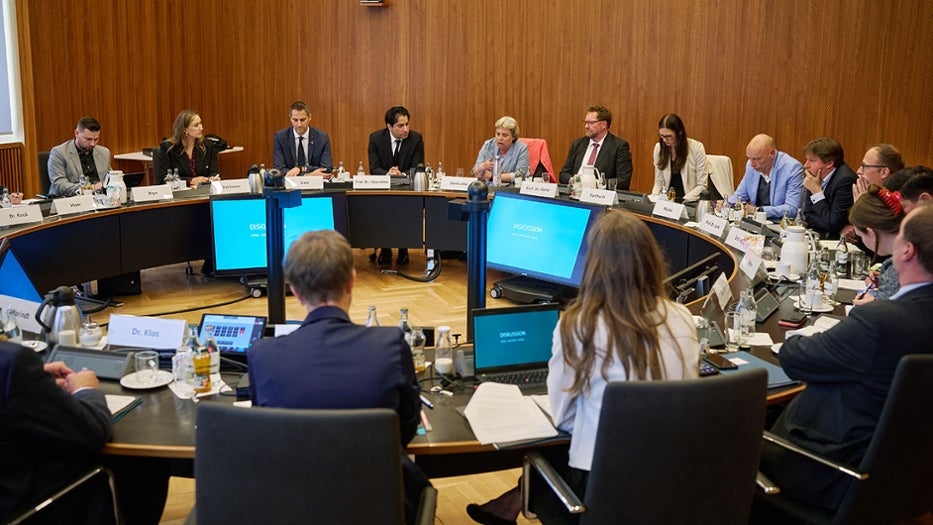
The German Federal Government’s recent decision to make its Task Force on Islamism Prevention within the Federal Ministry of the Interior a permanent committee is another step to deepen the criminalization of Muslim civic activity.
New Policy for a New Government
Following recent elections in Germany, a new coalition of Christian Democrats (CDU and CSU) and Social Democrats (SPD) was established in March this year. The coalition agreement from May 2025 included new proposals regarding Germany’s policies towards Muslims. These have historically been shaped by law-and-order, putting Muslim associations under systematic surveillance. The new agreement elevated the “Task Force on Islamism Prevention” to be established as a permanent body in the Federal Ministry of the Interior. The agreement says that it is charged with developing an action plan for the federal as well as state levels for combating Islamism.
On the one hand, this is an institutional upgrading of the issue. On the other, this measure is not based on any reinvention, but rather represents a further development of similar measures from the past. For example, there was briefly an Expert Circle on Political Islamism (Expertenkreis Politischer Islamismus), which was later dissolved by the coalition of SPD, Greens, and Liberals (FDP). There is little doubt that this topic is especially high on the agenda of the center-right Christian parties CDU and CSU. Their representation in the national parliament had already accepted a position paper on so-called political Islamism in April 2021. And the notion of ‘legalistic Islamism’ describing a non-violent form of organized Islam that works within democratic institutions has been institutionalized as the main target of the domestic intelligence service in the early 2000s. This approach essentially places all politically active German Muslims under suspicion.
Criticism of the new appointments
It didn’t take too long for criticism to come, which mainly focused on the membership of the Task Force. The daily TAZ wrote that the new composition of the task force is characterized by “numerous highly controversial individuals who have attracted attention with sweeping and in some cases racist statements about Muslims.” It went on to say: “The definition of what Islamism is will foreseeably be shifted into highly religious milieus,” which would in turn foster more mistrust toward Islam rather than constitute a program against Islamism. The journalist Daniel Bax wrote that while it is “of course” necessary to have “serious strategies and measures against religious radicalization,” the “fight against extremists … can only be carried out with the majority of Muslims.” Sharp criticism also came from Green MP Lamya Kaddor, who asked how policy for Muslims could be made with “people … who regard almost every form of Islam as a kind of dangerous ideology.”
The selection of the members is indeed a reason for contestation, though hardly astonishing. Its head is Christoph de Vries, undersecretary of the Ministry of Interior. Another prominent member is Ahmad Mansour, who has a long history of making anti-Muslim racist statements.
As Germany’s weekly Spiegel revealed in 2023, Christoph de Vries was a useful hawk for the Swiss detective firm Alp Services, which received millions of dollars from Abu Dhabi for their services to smear potential enemies of the United Arab Emirates, amongst them primarily Muslim institutions in Europe. As the Spiegel reported, “one of the company’s most successful projects focused on destroying the reputation of Islamic Relief Worldwide (IRW)” and de Vries was of useful help for Alp Services.
As of the award-winning author of Arab-Israeli background Ahmad Mansour, an October 2025 investigative report by Correctiv revealed that Mansour was awarded a project against antisemitism amounting to nine million euros by the Federal Ministry of Education and Research, even though expert reviewers had voiced serious reservations about it. The project’s aim is to develop strategies against “Israel-related antisemitism and Islamist radicalization for German schools.” Critics note that such efforts would conflate the criticism of Israel, which is legally protected, with the issue of antisemitism. Further, Mansour has a history of making anti-Muslim statements. In July 2021, he said during a podcast for the Frankfurter Allgemeine Zeitung: “Islam has never integrated into another culture and won’t do it in Europe.” These are just two of several names associated with the new task force that have a long history of Islamophobia.
But is it really just about the appointments? Should more Muslims be part of the Task Force as the Germany-based theologian Scharjil Khalid suggested? As well-intentioned as these criticisms are, they only scratch the surface of the problem.
Colonial forefathers
Ideas about a lurking danger posed by politically active Muslims draw on much older structures. While concepts such as “legalistic Islamism” or the newer “political Islamism” are more recent, these ideas draw on a much older one: Pan-Islamism. When the German Kaisserreich colonized territories in several regions of Africa inhabited by Muslims, the Kaiserreich worked with conspiracies surrounding Muslims: The early term of pan-Islamism comes from precisely this period. It can be considered a creation of Western academic ideas produced by Islamic studies scholars in the service of the colonial policy of the German Empire. At the moment when Muslims organized against colonial power, any form of social organization outside the control of the Empire was criminalized. That way, any legitimate resistance of the colonized was delegitimized.
Postcolonial continuity
The term legalistic Islamism, or political Islam have been institutionalized in the German context by the domestic intelligence service. From the very beginning, it served to criminalize explicitly non-violent forms of religious-political interpretation and activities. It placed Muslim organizations under suspicion and surveillance, especially through the domestic intelligence agency’s annual public reports, which led to stigmatization, and eventually social exclusion. That this criminalization of politically-active Muslims, ongoing for more than 20 years, has been largely unsuccessful is shown by contemporary examples of Muslims who aren’t members of associations or organizations. . These social media influencers, who construct their own version of Islam outside the world of religious associations and, in view of rampant anti-Muslim racism, seem far less positively inclined toward German elites.
In a combative tone, Federal Minister of the Interior Alexander Dobrindt (CSU) has announced that in the past “too much leeway was given to the enemies of the constitution,” and that this is now to change. This shrill tone bodes nothing good.
Solutions?
So what would the correct response to the newly created body in the Ministry of the Interior look like? It is not enough to staff the circle with people who genuinely research the relationship between Islam and politics and provide expertise instead of ideological slogans. It is also not enough to appoint Muslims to the body who are not brimming with Islamophobia or internalized Muslim self-hatred or inferiority complex. Nor is it enough for other people to propose gentler methods of dealing with so-called political Islamism.
The problem lies in the institution’s basic assumptions themselves. Ultimately, it is a symptom of a much deeper problem. Just as Jews were excluded 100 years ago through baseless accusations—for instance, the claim that “Judaism is not a religion, but a political organization” and that they formed a “state within a state”—so today we are witnessing very similar patterns of conspiratorial suspicion toward Muslims.
The central issue is that anti-Muslim racism has become so ingrained in German society that it shapes prevailing ways of thinking about Islamism and the risks it is believed to pose. This dynamic, which often diminishes both Muslims and Islam itself, makes it easier for the state to justify extraordinary measures in the name of security. This is precisely what must be challenged.
Farid Hafez is a senior researcher at The Bridge Initiative. His forthcoming book is Governing Islam in Austria and Germany. From Colonial Times to the Present with Oxford University Press.