Jack Taylor/Reuters
Pride or Prejudice? The English Flag and the Racialization of Belonging
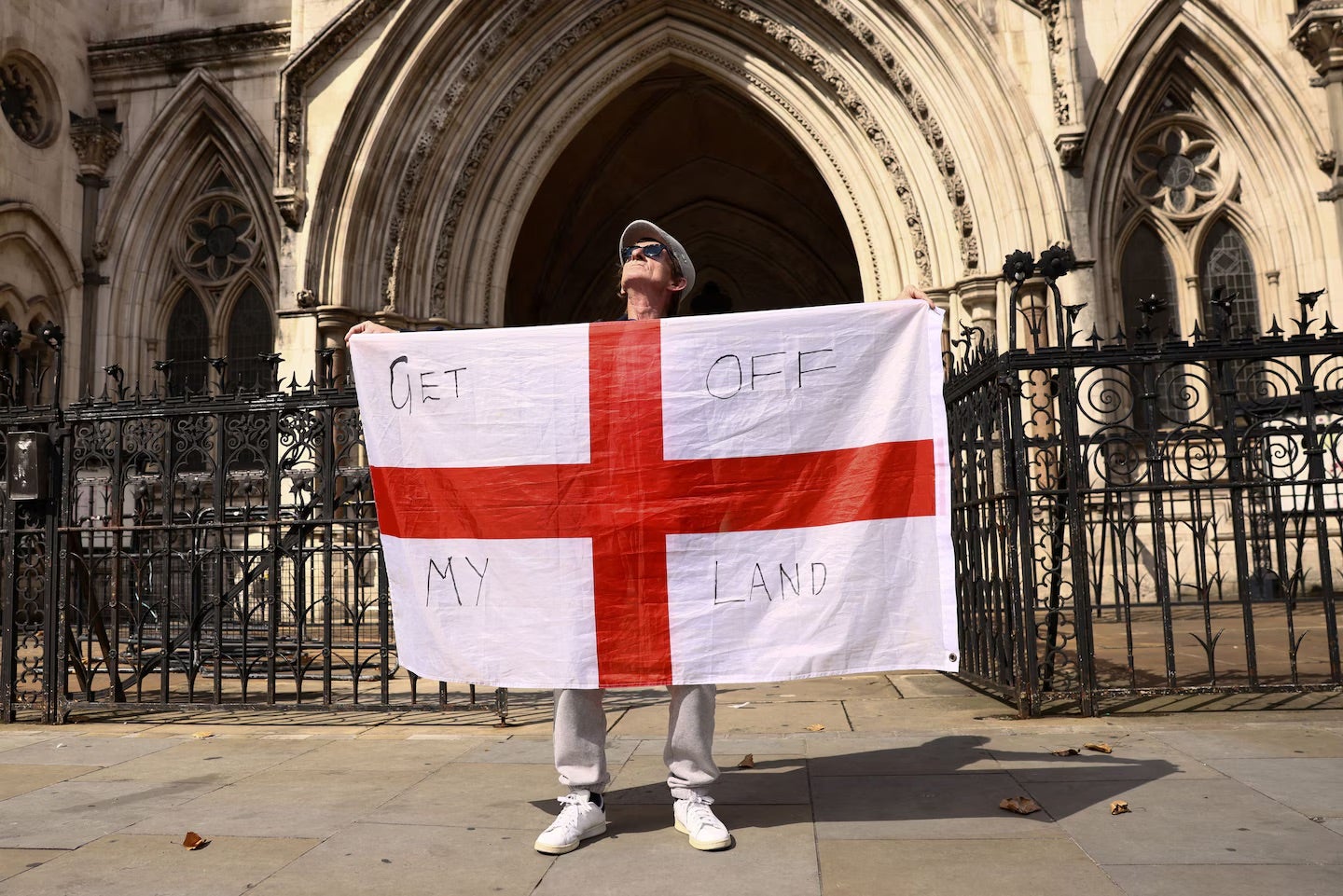
In recent weeks, there has been a visible resurgence of national symbols across the United Kingdom, particularly the Union Jack and the English flag bearing Saint George’s Cross. These flags have been hoisted from lampposts, draped over bridges, and even painted onto roundabouts. While some describe this grassroots movement as an expression of national pride, the displaying of these flags has also been closely associated with anti-migrant and anti-Muslim hostility. Several incidents illustrate this connection: mosques across the country have been vandalized with white nationalist graffiti, and individuals carrying the English flag have been documented verbally harassing and targeting Muslims.
These displays are also taking place against the backdrop of intensifying and often hostile debates over immigration, particularly with respect to immigrants of color. Notably, there has been little resistance to the arrival of Ukrainian refugees, underscoring the racialized dynamics of these debates. Rather than challenging the exclusionary narratives advanced by far-right parties such as Reform, mainstream political actors have adopted similar rhetoric. The Labour Party—the current ruling party—recently celebrated its record of “delivering for Britain” by deporting 35,000 people, presenting itself as tough on immigration.
Far-right and anti-Muslim actors have framed immigration as the central political issue, portraying immigrants of color and Muslims as the primary causes of social and economic issues, including child sexual exploitation (CSE), job scarcity, and rising cost of living. In this discourse, Muslims and migrants of color become convenient scapegoats, diverting attention away from structural drivers such as government ineffectiveness, institutional failures, and widening economic inequality. These narratives have been amplified online by far-right figures and organizations, who profit from the circulation of hate—whether through financial gain or the accrual of influence and visibility on social media platforms.
“Operation Raise The Colours” is the social media campaign behind the flag protests. While the movement claims to be about patriotism and pride in England, a recent investigation by HOPE Not Hate revealed that it is driven by “hardened and extreme far-right activists.” Among it key organizers is Andrew Currien (also known as Andy Saxon), a convicted criminal and longtime ally of fellow convicted criminal and anti-Muslim figurehead, Stephen Yaxley-Lennon (better known as Tommy Robinson). Currien currently runs security for the far-right party, Britain First, which HOPE not Hate also revealed is claiming to have provided “75%” of the flags in the North West.
Although the campaign presents itself as a celebration of national pride, it is being organized, promoted, and supported by individuals who have a history of stoking anti-immigrant and anti-Muslim sentiment. Robinson, for example, has actively promoted it through his large social media platforms. For decades, he has used his social media presence to spread disinformation and conspiracy theories about Muslims, primarily the racialized “Grooming gangs” narrative, and that British Muslims are a threat to “British values”.
The campaign’s reach has also been amplified internationally. Elon Musk, while not British, has increasingly injected himself into the UK’s political discourse through his platform on X, where he has over 224 million followers. He recently shared the English flag in a nod to the “Operation Raise The Colours” campaign, one of many posts in which he rails against “mass migration” and “open borders.” His posts frequently link crime and poverty to immigration, often tying perpetrators’ ethnic and religious identities to acts of violence.
Musk has frequently advocated for “remigration,” a concept originating in European far-right circles that carries explicit exclusionary connotations. A February 2025 InfoMigrants piece noted that the term has been “effectively repurposed to push an exclusionary agenda.” Similarly, in an October 2024 interview with the Guardian, Omran Shroufi, a post-doctoral researcher at Vrije Universiteit Brussel, noted that the term has become more mainstream due to “centrists and mainstream politicians” legitimizing the discourse on migration, which has allowed the “the far right to play an outsized role in shaping the political conversation.”
In recent weeks, there have also been several incidents of mosques being targeted, vandalized, and graffitited, as well as Muslims being harassed and attacked. In the last week of August, the South Essex Islamic Centre in Basildon was defaced, with red crosses painted across its walls alongside the words “Christ is King” and “This is England”. In Liverpool, there were several incidents including homes being “spray-painted with malicious messages such as ‘Locals only’ and ‘No Islam’, and the St George’s Cross daubed on several sites nearby.” As a result of the increased attacks, mosques across the country are tightening security measures.
Along with incidences of graffiti and vandalization targeting mosques, businesses have also been targeted. At the end of August, a Chinese takeaway in York was vandalized and graffitied with racist messages including “go home”, alongside the word “England” and red crosses. As a result, many British Muslims along with other ethnically diverse communities are concerned for their safety, as the current charged atmosphere appears to be one of exclusion dressed up as national pride.
In an interview with Al Jazeera, Wajid Akhter, head of the Muslim Council of Britain, said, “The St George flag is a symbol of England we should all be proud of. For it to be used in this way, [which] echoes how Nazis targeted Jewish homes, is a disgrace to our flag and our nation. Silence has allowed hate to grow.”
Some British Muslim communities have turned the messaging around by actively reclaiming the flags. A number of mosques across the UK have displayed them, sending a defiant message to those who seek to exclude them, stating, “this is our flag too…We’re embedded in this country and we’re a part of the fabric of society.” The South Lakes Islamic Centre in Cumbria is one such mosque that displayed the Union Jack, with its spokesperson saying, “The flag symbolizes our shared belonging and our commitment to building unity, friendship, and a home for all.”
There is nothing inherently problematic about expressing pride in one’s country by displaying national flags. However, “Operation Raise The Colours” takes on a different meaning given that it is organized by known far-right figures and supported by individuals with a record of spreading xenophobic, racist, and Islamophobic content. In this context, the flag becomes more than a symbol of national pride. For many within this movement, it functions as a symbol of exclusion directed toward Muslims and immigrants of color. Indeed, a recent poll found that 42 percent of the British public view the campaign as a political statement against immigrants; three in five of those same Brits said they want to see more flags on lampposts and roundabouts. What is presented as patriotism often serves, in practice, as a cover for the expression of racist and Islamophobic attitudes.