[Source: Getty Images]
Extending Islamophobia to ‘inner enemies’: the spectre of Islamo-Leftism in France and Britain
Introduction
‘Woke’, ‘Islamo-leftist’, ‘extremist’, ‘sectarian’: these are only a few among the accusations launched against several Western green and left-wing parties (as well as civil society associations, academics and journalists) who raise awareness about Islamophobia, anti-migrant racism, and Israel’s genocide in Gaza. Such unhinged criticism frequently comes from right-wing figures: think, for instance, of the Republican Party representatives’ crusade against the Democratic mayor of New York City, Zohran Mamdani, part of a larger vitriolic campaign against American Muslims. Yet, narratives have also percolated into centrist parties, often prone to put on the same plane the “two extremes” (Right and Left), neglecting that attacks carried out by far-right and white supremacist individuals have been far more lethal than left-wing ones.
In this article, I want to illustrate and reflect on this broader trend by focusing more deeply on French politics, with additional examples from other countries (chiefly the UK). Many progressive actors are increasingly targeted by a barrage of denigratory epithets and policy measures because of their commitment to tackle Islamophobia and anti-Palestinian racism. In its most common forms, those qualified as “Leftists” are blamed for conspiring with loosely defined Muslim Islamist groups to transform European “white” demography, eradicate secular and gender norms, and steer foreign policymaking towards anti-Israeli positions.
The debate on Islamo-gauchisme in France
France is the best example of this trend. Some academics, journalists and activists have resorted to a port-manteau word, Islamogauchisme (‘Islamo-leftism’), to define the alleged ideological and tactical convergence between sections of the far-left and Islamists groups. The notion is used in a deliberately ambiguous way, as it does not clarify who belongs to either camp. Its origins are contested. Ibrahim Bechrouri links current preoccupations with Islamo-leftism to the concerns raised by the French military in the 1950s-60s about a potential “red green” alliance between anticolonial movements in North Africa and West Asia and the USSR. Similarly, in 1954, Bernard Lewis (whose orientalist outlook is well known) warned that Islam could become a Trojan horse for the penetration of communism.
In a recent genealogical analysis of the concept, Hajjat argues that the Lebanese academic Béchara Ménassa first coined it in relation to the factions fighting in the Lebanese civil war (1975-78). Ménassa identified the unlikely alliance between a Wahhabi theocratic regime (Saudi Arabia) and an Arab socialist one (Gaddafi’s Libya) as a pure example of an Islamo-leftist front. Despite this invention, most works on Islamo-leftism trace back its pioneering use to an obscure publication in 1994, in which the Trotskyist Socialist Workers Party’s leader Chris Harman analysed the opportunities of tactical alliances between far-left and Islamist groups in countries like Iran, Sudan and Egypt. In the early 2000s, after the second Intifada, the notion was put forth by French political scientist Pierre-André Taguieff to alert about a heterogeneous alliance of radical Islamists, alter-globalist and extreme Left groups coalesced around pro-Palestinian and anti-Israeli positions, defined as a form of “new antisemitism”.
The narratives suggesting hidden alliances between parties on the Left and ethnic minorities are historically part and parcel of right-wing talking points. Interior enemies (progressive personalities) are accused of being Trojan horses and fifth columns of agents who are external to the national political body (exterior enemies). This discourse recalls past conspiracy theories, such as the antisemitic myth of ‘Judeo-Bolshevik’ – namely that Jews orchestrated the Russian Revolution and were behind the worldwide diffusion of communism. Extreme right groups and accounts frequently evoke the hidden threat to the West coming from alleged Islamo-leftists. Think, for instance, of the death of Quentin Deranque, a French militant harbouring neo-Nazi and catholic traditionalist sympathies. Deranque died in Lyon several hours after a violent brawl erupted between his group and far-left militants. The casus belli was the scheduled talk of Franco-Palestinian EU MP Rima Hassan (La France Insoumise) at the Institute of Political Studies of Lyon. Deranque and other extreme right folks gathered outside of the conference venue to protect the femonationalist group Némesis, which contested the presence of Hassan by showing a banner saying “Islamo-leftists, out of our universities!”.
Despite Islamogauchisme being used by far-right vocabulary and media (e.g., Valeurs Actuelles, Frontières), it has also entered mainstream politics. In the Socialist Party’s 2017 primary elections, the supporters of Manuel Valls (former Prime Minister and representative of the right-wing party factions) accused the other candidate Benoît Hamon (a more progressive candidate, who eventually won the primary) of complicity with Islamo-leftism. Years later, the tragic murder of teacher Samuel Paty by a Chechen Muslim refugee, likely inspired by Daesh, triggered a national debate on Islamism and the subsequent adoption in 2021 of the ‘Law upholding the principles of the Republic’ (aka Law against Separatism). In this context, prominent Cabinet members of Emmanuel Macron’s party Renaissance pointed the finger at Islamogauchisme. The then-Minister of Education Jean-Michel Blanquer accused Islamo-leftists of being ‘intellectual accomplices of the crime’. One year later, the Minister of Higher Education Frédérique Vidal (who had previously distanced herself from Blanquer’s comments) added that Islamogauchisme “gangrened French academia and society”. As Vidal recommended a national enquiry to distinguish between “scientific and politicised” research, she caused an uproar among some academics: more than 600 signed a letter demanding her resignation. Yet, the words of Vidal and Blanquer resonate with other academics who position themselves as defenders of French laïcité and a colour-blind universalist model, rejecting the word Islamophobia and what Macronist Minister Gérald Darmanin defined as “Anglo-Saxon courses on racism”, whose scientificity is constantly questioned. An open letter in Le Monde even denounced the “indigenist, racialist and decolonial ideologies” imported from North American campuses. In this respect, the worries about Islamogauchisme cannot be read in isolation from the cottage industry of pamphlets and media interventions denouncing so-called “wokeism” issues. The moral panic and witch-hunt against wokeism is reflected by the number of academic and press articles including this concept, which overtook those on Islamogauchisme in 2022.
Yet, specific references to Islamo-leftist threats gained momentum after the October 7 Hamas-led attacks against Israel, mostly to accuse left-wing parties of implicitly condoning or ignoring Islamist terrorism for both ideological and electoral reasons. The public intellectual Michel Onfray published a volume on the genealogy of Islamogauchisme in which he defines the intellectual fascination of the French Left for Islamism as “the other collaboration”, in an appalling comparison with the Vichy regime’s collaboration with Nazi Germany. After the 2026 municipal elections, media pundits shamelessly defined the pro-Palestinian mobilisation by LFI as the “Gaza strategy” to lure, among others, Arab-Muslim voters living in the banlieues. On the side of political parties, the far-right Rassemblement National (RN) has often qualified LFI and other left-leaning groups as Islamo-leftists who are dangerous for the French state. In August 2024, the RN drafted a bill to suggest a commission of enquiry on the “infiltration into Higher Education of ideologies opposed to the values of the Republic”, denouncing the threat, damages and actions of “woke and Islamo-leftist” mobilisation – namely the pro-Palestinian activism – in universities like SciencesPo Paris. Interestingly, the party Les Républicains (junior partner in Macron’s appointed Cabinets) had already presented a similar bill four months earlier, showing that, when it comes to blaming Muslims, the boundaries between centre-right and far-right are blurred. LR is quite vocal in denouncing the Left for allegedly being too indulgent towards Muslims’ grievances, which are automatically associated with a symptom of political Islam. LR representatives even set up a parliamentary commission of enquiry to investigate Islamist infiltration among political parties. This stratagem was thought from the very beginning to target only one party, LFI, but expectedly failed to deliver proof of alleged Islamo-leftist conspiracies. LR President Bruno Retailleau even argued that LFI promotes a “new antisemitism that drinks from the springs of Islamo-leftism”. While it is true that Mélenchon has sometimes used antisemitic dog-whistles, the defamatory campaigns against the Left (as the greens and communists are not immune from accusations) seem disproportionate. Surely, the LFI-bashing has turned into a profitable literary genre, as shown by publications defining LFI as no less than “accomplices of evil” and “passionately antisemites”.
Translating ‘Islamo-leftism’ in other countries?
While the literal translation of Islamogauchisme – Islamo-leftism – is not a common label used in British political discourse, some mentions to putative threats by anti-Western Left-Islamic alliance can be found among conservative talking points. As explained by Jonathan Galton, who has worked on comparative research on Islamo-leftism, it is at least since 2003 that “supporters of the Iraqi war in the US and UK derided the anti-war movement as an unholy alliance between radical Islamists and the Left”. In Britain, the claims about suspicious alliances between progressive left-wing politicians and Muslims have long targeted former leader of the Labour Party, Jeremy Corbyn, and his anti-imperialist followers. Because of what often appeared to many as too indulgent an attitude towards Islamist groups (e.g. Hamas and Hezbollah) and of his opposition to airstrikes in Syria in 2015, Corbyn has been caricatured as a ‘terrorist sympathiser’ and an ‘antisemite’, such as by David Cameron and by right-wing media. Moral panics about Islamist penetration of the British establishment through the Left have then emerged in relation to Your Party, Corbyn’s political formation co-created with Zarah Sultana and other former Labour Left and independent MPs. The reason is that this leftist political formation has outspokenly criticised Keir Starmer’s inaction in the face of Israeli genocide in Gaza and sided with pro-Palestine marchers, attracting vitriolic attacks by the conservative press – The Telegraph even mentioned an “ugly relationship” between Islamism and the Left.
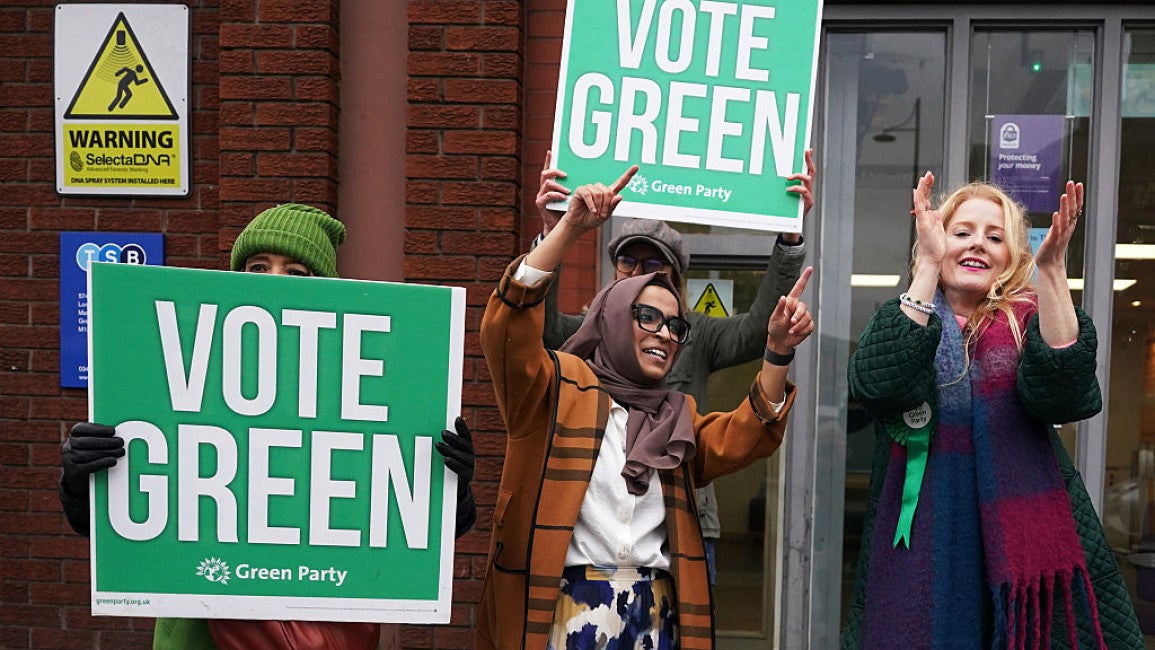
Since the election of its new leader, Zack Polanski, the Green Party has been targeted by a similar smear campaign. Polanski is a staunch advocate of Muslim rights and quite vocal in denouncing mounting Islamophobia and Israel’s war on Palestinians – that has so far caused at least 73,000 casualties. Let’s look at Manchester’s Gorton-and-Denton by-election held last February, where the Greens’ victory was partly due to their ability to drain many voters of Muslim background from Labour, which, in turn, has alienated much of these constituencies since 2024. What followed was a series of allegations raised by Reform UK and Labour against the Greens, based mainly on two narratives. First, that the Greens had played sectarian politics by actively seeking the “Muslim vote”, as if the latter was a monolithic bloc easy to manipulate. Second, that Hannah Spencer’s unexpected success owed to forms of electoral fraud, manifested in putative “Muslim family voting”, as family members (read: Muslim men) dictated to others (read: Muslim women) whom to vote for. Aside from criminalizing and essentializing a large portion of the British public, this narrative deprives Muslim women of their agency, casting them as submissive to their partners and ignoring that progressive left-leaning views are increasingly widespread among the female public. In a context of consistent Islamophobic media coverage, the Greens are portrayed as wittingly lending themselves to Muslim infiltration. The Reform candidate defeated by Spencer declared that the vote was “rigged by the Islamo-green party” who used “Muslim clan networks”. These talking points are so mainstreamed that even a Green former deputy party leader, Shahrar Ali, has recently claimed on the Free-Speech Union podcast that Greens are a danger to society because now led by an unholy alliance of Islamists and gender ideologues.
A similar pattern has emerged in the US after the election of the Democratic-Socialist Zohran Mamdani as mayor of New York City in November 2025. Due to his Muslim background and his progressive social-democratic and anti-racist platform, Mamdani is targeted by a mix of Islamophobic and anti-communist tropes, in a 2.0 McCarthyistic crusade that frames him as an “inner enemy”, “antisemite”, and “Trojan Horse” of Islamism. Other European countries witness the diffusion of these narratives. In Spain, the label Islamo-izquierdismo has been used in relation to “French culture wars”, but the Catalan far-right independentist party Aliança Catalana translated the label as Islamoesquerranisme to attack the local left-wing parties’ Muslim constituencies and show its support for Israel. In Italy, part of the conservative press has portrayed left-wing activists and parties as being in a symbiotic relation with Islamist extremists, Hamas sympathizers and the October 7 attackers. In Germany, the Konrad Adenauer Foundation (associated with the CDU) published a demeaning portrayal of pro-Palestinian protests, framed as “barely disguised pro-Hamas rallies” in which “woke left-wing extremists” and “Islamists” express common fascist tendencies and genocidal antisemitism. Ironically, the author of the report borrows an antisemitic dog-whistle to warn about the Muslim Brotherhood’s “tentacles” reaching inside the Ministry of the Interior’s Islam Conference. This kind of warning aligns well with the CDU-SPD’s coalition government’s decision to make its Task Force on Islamism Prevention within the Federal Ministry of the Interior a permanent committee.
Conclusions
It is undeniable that some left-wing parties, far-left collectives, civil society associations and groups led by Muslims concur on the fight against imperialism, colonisation, racism, and Islamophobia. Still, deducing from this convergence that Muslims are subtly using the Left to infiltrate Western societies is conspiratorial reasoning. This argument leads to delegitimizing Muslims, essentialized as a monolithic bloc aiming to impose antisemitic and bigoted views, and progressive voices, depicted as a Trojan Horse of Islamism. The concept of Islamogauchisme lacks scientific basis, but its “spectre” still haunts both far-right and mainstream parties. Its geographical breadth is not limited only to France, as demonstrated by the previous illustrations. The narratives about a putative Islamo-leftist threat also read like a repackaging of old antisemitic tropes about Judeo-Bolshevism. They risk putting in physical danger whoever harbours antiracist beliefs and warns about Islamophobia, as they might be potentially accused of conspiring with fantasized Muslim enemies who want to infiltrate Western society. As a reminder of the lethal threat, let’s not forget that Anders Breivik (who killed seventy-seven people in Oslo and Utøya in 2011 to halt what he described as the ‘Islamization of Norway’) specifically targeted members of the youth branch of the Norwegian Labour Party, in the deadliest extreme right terrorist attack of the last two decades.